
How Spot, the robot dog, is changing plant inspections

What does it mean to introduce AI and robotics into a cement plant? We speak with Shamraiz Ali about Spot, an autonomous inspection robot piloted in Leimen. We discuss how inspections work in practice, what challenges teams face on the ground, and why early detection can make a real operational difference.
What kind of inspections need to be carried out at a cement plant, and why are they important?
Inspections are part of everyday operations. They are essential to keep the facility running safely and continuously.
At Leimen, we work with grinding units, which are just one part of the overall cement production process. Even in this part of the plant, there are many things that need to be checked regularly. Operators look at how heat develops across different assets, they listen for unusual sounds, and they check for leakages e.g., air flowing through pipes.
These inspections rely heavily on human senses: sight, hearing, and sometimes even touch. For example, operators may try to feel whether a component is overheating.
The challenge is that all of this happens while the plant is running. Grinding mills are extremely loud, so it is difficult to hear clearly. If you want to take precise measurements, you need to carry additional equipment. Without that, many issues are hard to detect. You cannot always physically interact with running equipment either. For example, you can't touch an operating motor to check its temperature.
And as a human, you’re not able to monitor everything at the same time. There are always limitations in terms of attention and perception.
So overall, inspections are critical, but they are also complex, time-consuming, and not always easy to perform with full accuracy.
In simple terms, what is Spot? What can it do during an inspection?
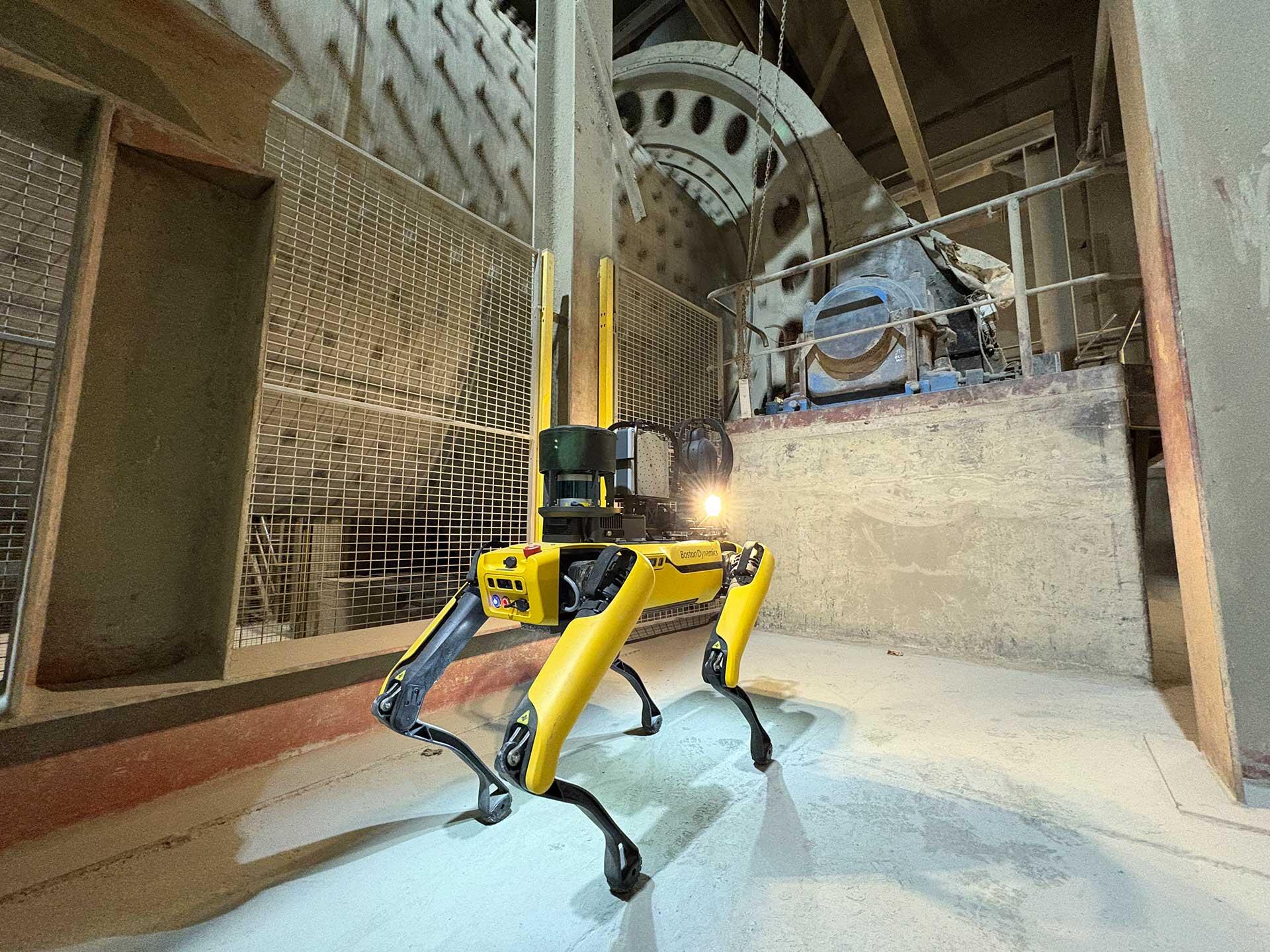
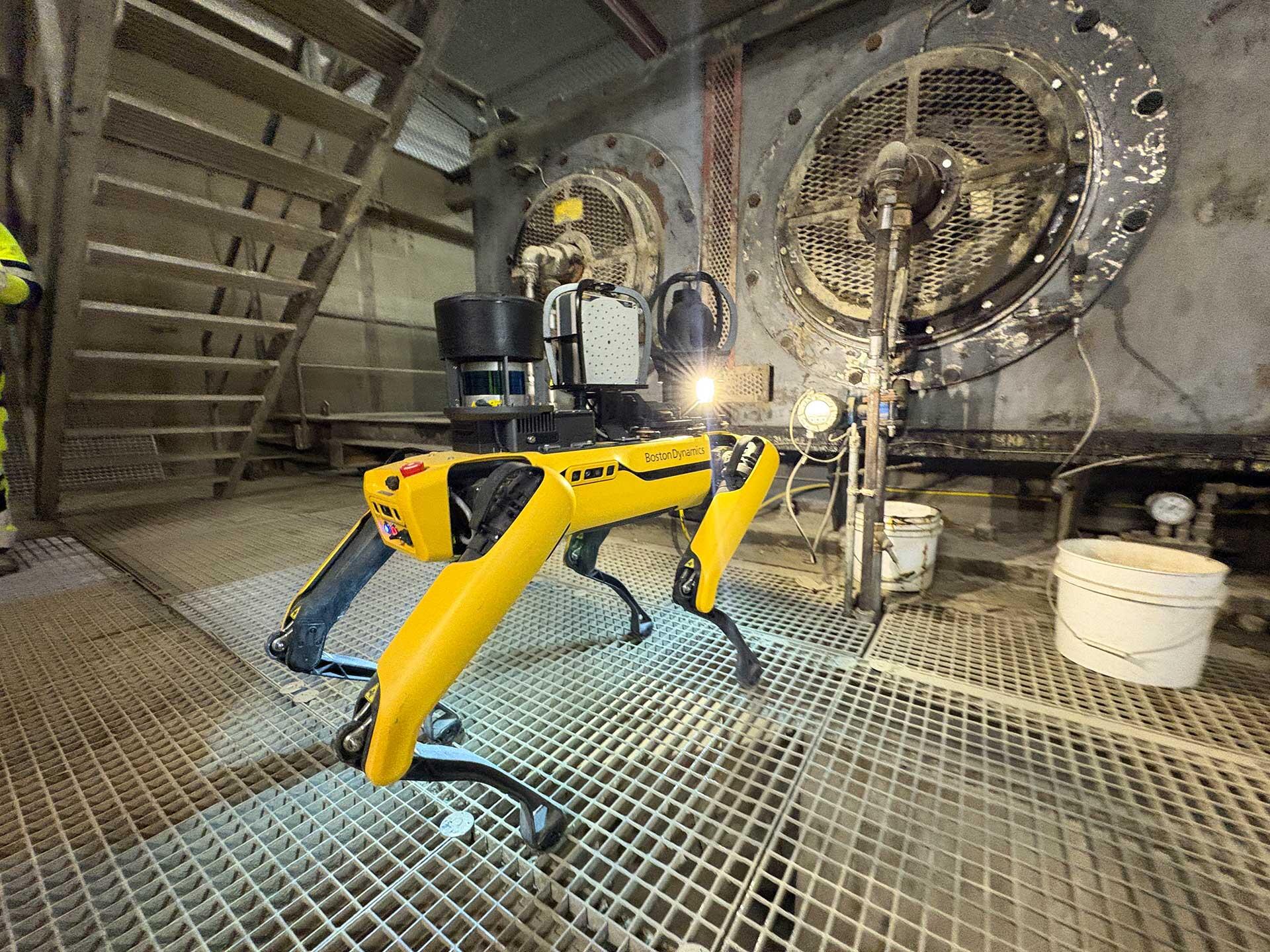
Spot is an autonomous robot designed by Boston Dynamics that performs inspections at the plant. It operates through predefined missions. It moves through the plant and inspects specific assets that we have trained it to monitor.
Meanwhile, it collects data using different sensors and immediately evaluates that data. That’s an important point – Spot doesn’t just gather information; it also helps interpret it in real time.
Compared to a human walking through a plant, Spot can continuously monitor multiple parameters at once, without being affected by noise or environmental conditions.
How does a typical inspection look?
Spot follows a schedule. It starts a mission at a specific time, move through different floors of the facility, and inspect assets along the way. While it is running, it sends real-time data and alerts via the network. Once the mission is complete, it returns to its docking station and recharges.
Now, Spot covers more than 170 inspection points. These were defined in close collaboration with the maintenance team, who know the plant best.
How does this compare to traditional inspections?
In a traditional setup, inspections are usually done by someone walking through the plant and checking key assets. However, this process is not always standardized. There isn’t necessarily a fixed list of inspection points that is followed every time. People tend to focus on what they consider most important or critical, based on their experience.
With Spot, the approach is more structured. The inspection points are predefined, and every mission follows the same logic. That means we get consistent data and a more complete picture over time.
What kind of data does it collect?
The data depends on the sensors it uses. For example, with the thermal sensor, Spot creates thermal images and heat maps of assets. This allows us to see how temperature is distributed and whether there are any abnormalities.
It also uses acoustic sensors, which are particularly useful in a noisy environment. These sensors filter out background noise and can detect air, gas, or steam leakages. They can even pinpoint the exact location of a leak.
In addition, Spot performs vibration analysis, helping us understand whether machines are operating within normal parameters.
And finally, it uses high-definition cameras to capture visual data that can be used for documentation or comparison over time.
What is Spot not designed to do? What misconceptions might employees have?
A common misconception is that robots like Spot are meant to replace people. That is not the case here. Spot is designed to support plant teams, not replace them. Its role is to provide additional data, improve visibility, and help detect issues earlier. Human expertise is still essential to interpret results, make decisions, and carry out repairs.
What challenges led Heidelberg Materials to explore robotic inspections?
One of the main drivers was predictive maintenance – the ability to detect issues before they turn into failures.
Early detection is crucial because it helps avoid downtime. The goal in any plant is to keep operations running continuously. If a failure occurs unexpectedly, it can stop production. Early detection allows the team to intervene before it happens.
Another challenge is consistency. Manual inspections can vary from person to person: how they check things, what they focus on, and how they document it. Spot introduces a more standardized approach. It follows the same routines, checks the same points, and records data in a consistent way.
Do you have an example where Spot helped identify a problem early?
Yes, recently Spot detected a blockage in a cyclone within the grinding unit, several days before it became a serious issue. We had set up Spot to monitor two specific points using thermal imaging. Normally, these components appear hot. They show up as red on the thermal image. But in this case, one of them started turning blue, which indicated a drop in temperature. That was a clear sign that something was wrong.
Spot generated multiple alerts, and the team was able to investigate and fix the issue before it caused downtime.
What was the biggest challenge during implementation?
The biggest challenge was connectivity. Spot is an IoT (Internet of Things) device, so it relies on a reliable connection. Cement plants are not always highly digitalized environments, so we had to build the network infrastructure first.
We also had to consider cybersecurity. Any new system needs to be carefully evaluated to ensure it is safe to integrate into the existing environment.
From a business perspective, what is the main value of Spot?
The biggest value is early detection. For example, air leakages are very common in plants, and they lead to energy losses. If Spot detects them early, they can be fixed quickly, which directly reduces costs.
Another benefit is precision. When Spot identifies an anomaly, it tells us exactly where to look. This saves time and makes maintenance more efficient. And over time, the data collected by Spot allows us to identify trends, which is a key part of predictive maintenance.
What improvements have you observed overall since Spot was introduced?
One of the biggest improvements is the level of digitalization. To make Spot work, we had to set up infrastructure, which now enables other use cases as well, for example, using Wi-Fi cameras.
We also now have better documentation. Data is collected consistently, stored, and can be analysed over time. Before, some information might have been written down but not integrated into any system.
Another improvement is the standardization of inspections: both in how they are performed and how they are documented.
What are the next steps?
There are several directions being explored. One is creating a digital twin – a 3D model of the facility – using additional sensors. Spot would move through the plant and capture precise spatial data, creating a digital representation of the environment that can be updated over time. This would make it possible to document the condition of the plant in greater detail, compare changes in time, and connect inspection findings to a specific location. In the future, the digital twin could improve maintenance planning, support remote analysis and integration with other systems.
Another is expanding inspections, for example to kilns and refractory bricks.
Remote operation is also an important topic. The idea is that operators could control Spot from a control room and investigate issues without physically going into the plant.
Another one is exploring additional types of robots for different tasks. In cement plants the environment is very dusty, so cleaning is a constant challenge. We are considering robots that could help with cleaning, or even delivery robots that could transport spare parts and tools across the facility.
But if you look at the bigger picture, the real challenge is not just having multiple devices. It is making them work together in a coordinated way. That’s where this idea of orchestration comes in.
Are you exploring combining robotic inspections with drones?
Yes, this is a part of the mentioned idea that we call physical AI orchestration. It is about different devices, like robots and drones, not just operating separately, but communicating with each other and working together.
We are currently running a drone proof of concept. One of the main use cases is security and perimeter surveillance at night. Instead of sending personnel to patrol, the drone provides a live video feed to the control room. If something is detected, the team can react without putting employees at risk.
Drones can also be used for inspections in hard-to-reach areas, such as high structures. They can be equipped with sensors, including infrared, and can also be used for volumetric analysis, for example, measuring material stockpiles.
How do you see robotics shaping the future of plant operations?
Robotics, much like AI, is a strong trend, and we are only at the beginning of understanding its full potential in industrial environments.
Looking ahead, robotics will continue to add value, especially in areas like health and safety, where removing people from hazardous situations is a key benefit. Autonomous inspections will become more advanced, and we will likely see a broader range of industrial-grade robots being used across different applications.
Overall, I believe robotics will become an integral part of plant operations, enabling people to focus on higher-value tasks, work more efficiently, and in a safer environment.
- Spot has travelled over 90 kilometres in the facility
- It covers more than 170 inspection points
- It has performed nearly 10,000 inspections in 4 months